



DCONex 2026 trade fair review: News from asbestos analysis and pollutant management
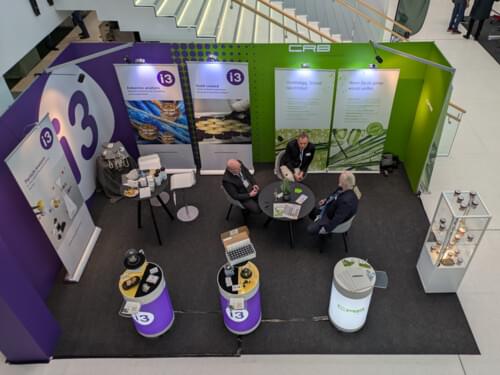
This year, DCONex was once again held at the Congress Centrum Halle Münsterland in Münster – the specialist conference with accompanying trade exhibition on pollutant management and building pollutants. Special thanks go to our partner i3 Membrane, with whom we were once again represented with a joint exhibition stand.
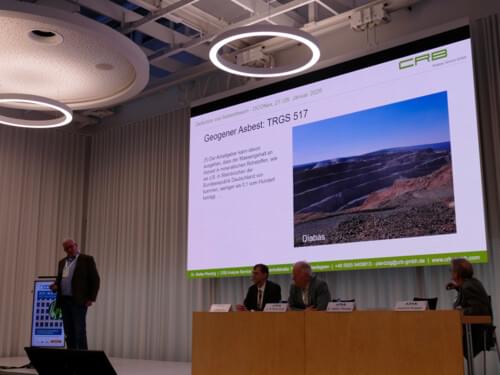
At DCONex 2026, the CRB team attended various sessions to learn about the latest developments in dealing with pollutants and once again took to the stage to report on the topic of asbestos analysis. This year, our laboratory manager Dr. Stefan Pierdzig gave a presentation on geogenic asbestos and our colleague Dr. Gunnar Ries moderated the workshop “Analysis of Amphiboles.” We summarize other important content from this year's conference in this follow-up report:
AI in asbestos analysis: opportunities and challenges
Artificial intelligence offers potential in the following areas:
- Predicting the recyclability of building materials
- Estimating waste and recycling volumes
- Supporting planning, construction supervision, and quality control
- Querying rules, standards, and regulations
However, high-quality training data and technical expertise remain prerequisites. AI complements analytics—but does not replace it.
Amendment to the Hazardous Substances Ordinance & adaptation of TRGS 519
The revised Hazardous Substances Ordinance (GefStoffV) has a direct impact on TRGS 519 (“Asbestos, demolition, renovation, or maintenance work”). Important points:
- Partial dismantling of asbestos-containing components (e.g., individual fiber cement or Floorflex panels) is possible within the scope of functional maintenance
- Specific requirements for spatial separation and labeling
- Documentation requirement for remaining materials containing asbestos
- Clarifications regarding the ban on covering (does not apply, for example, to asbestos-containing plasters, tile adhesives, and fillers; floating installation of carpet on floors containing asbestos is permitted)
- Greater obligation of participation and information on the part of the initiator
- Early technical investigation recommended as early as the planning phase
The aim is to ensure legally compliant implementation while strengthening occupational health and safety.
Die Expositions-Risiko-Matrix der TRGS 519
The exposure risk matrix of TRGS 519 remains the central tool for remediation planning. The matrix classifies activities according to the level of fiber release:
- Low exposure: 1,000–10,000 fibers/m³
- Medium exposure: 10,000–100,000 fibers/m³
- High exposure: > 100,000 fibers/m³
In principle, activities without sufficiently validated measurements are automatically assigned to the highest risk class. The continuous measurement program of the professional associations (BG Bau, BG ETEM, BG Holz und Metall) determines exposure values for various activities. These tested activities are to be published in Appendix 9 of TRGS 519. In order to generate sound data for future procedures, it is necessary for building owners to be willing to make their properties available for measurements.
Asbestos in construction waste: New standards for analysis and disposal
VDI 6202 Sheet 10 in practice
The relatively new VDI 6202 Sheet 10 closes a regulatory gap in the handling of construction waste that may contain asbestos. A distinction is made between demolition waste and waste from broken material:
Demolition rubble:
- Individual materials can still be identified.
- Coarse, unbroken pieces or entire components are recognizable.
Broken material:
- Individual components are usually no longer recognizable.
- The material has been relocated and processed.
At DCONex 2026, various sampling strategies were discussed: reconstruction of the building fabric in the case of rubble piles close to demolition, or division into sectors, searching these and, if necessary, creating trenches. Sampling itself is carried out in accordance with LAGA PN 98, and analysis in accordance with VDI 3876 or 3866 Sheet 5.
 Updated LAGA M 23: Significance for demolition and recycling
The old LAGA M 23 dates back to June 2015. The updated version introduces key changes:
- Consideration of mineral construction waste with low asbestos content
- Evaluation of new findings on construction products containing asbestos
- Assessment value for asbestos-free status: 0.01% by mass
Buildings constructed after October 31, 1993, are generally considered to be asbestos-free, provided there are no grounds for suspicion. In addition, buildings can be considered asbestos-free if they have been renovated in accordance with the current state of the art or if a corresponding expert certificate is available.
Construction waste with an asbestos content of less than 0.1% by mass can be disposed of as non-hazardous waste (waste code 17 01 XX, with the note “low asbestos content”); above 0.1% by mass, it is classified as hazardous waste (17 01 06). The extraction and marketing of rocks containing less than 0.1% by mass of geogenic asbestos remains permissible, provided that no technically added asbestos is present. Accordingly, chemical legislation permits the use of mineral construction waste as recycled building materials up to this threshold value.
However, the lack of a binding distinction between geogenic and technical asbestos remains problematic. LAGA M 23 merely refers to the testing methods and evaluation rules of TRGS 517 and to the assessment of respirable fibers according to the WHO definition. The following applies to recycling in principle: Only asbestos-free construction waste without technical asbestos is permitted; proof of asbestos-free status must be provided by the waste producer or owner.
Recycling of building materials: Time pressure vs. freedom from pollutants
There are clear challenges in building material recycling:
- Time and cost pressure on construction sites
- Complex material composites (composite building materials)
- Difficult separation on site
- High demands on processing plants
- Ensuring freedom from pollutants as a central prerequisite
Without reliable analysis, it is not possible to safely recycle mineral building materials.
Our brief summary of DCONex 2026
DCONex 2026 has once again highlighted how crucial it is to make a clear technical distinction between asbestos used in technical applications and so-called geogenic asbestos for the purposes of analysis, disposal, and recycling. You can read about why our testing laboratory is calling for clear guidelines on how to handle geogenic asbestos in this latest press release.
Der Fachkongress überzeugte wieder mit hoher inhaltlicher Qualität, insbesondere zu Asbestanalytik, Regelwerken und Recycling. Auch der fachliche Austausch mit anderen Ausstellern, Branchenvertretern und Kongressteilnehmern an unserem gemeinsamen Stand mit i3 Membrane war erneut ein echtes Highlight. Vielen Dank für die zahlreichen interessanten und anregenden Gespräche. Wir freuen uns schon jetzt auf die nächste DCONex am 26. und 27. Januar 2027.
The trade congress once again impressed with its high-quality content, particularly on asbestos analysis, regulations, and recycling. The professional exchange with other exhibitors, industry representatives, and congress participants at our joint booth with i3 Membrane was once again a real highlight. Thank you very much for the numerous interesting and stimulating discussions. We are already looking forward to the next DCONex on January 26 and 27, 2027.
You can read an even more comprehensive follow-up report on DCONex 2026 in the blog of our colleague Dr. Gunnar Ries: